Quick answer: Moving in Toronto in 2026 is shaped by three forces: a Bank of Canada policy rate holding at 2.25%, a housing market where sales are rising while prices remain below last year, and the sharpest slowdown in newcomer arrivals in a decade. Local moves in the city typically range from about $600 for a small express move to $8,000+ for a large white-glove house move, depending on size, access, and services. This guide, written by the team at CARGO CABBIE, Toronto’s most awarded premium moving company since 2010, covers everything: real costs, condo and house moving, downsizing, packing, storage, and exactly how to choose movers you can trust.
Table of Contents
- Why Moving in Toronto Feels Different in 2026
- The Canadian Economy: What It Means for Your Move
- Global Changes Hitting Home in Toronto
- Immigration: The Quiet Force Reshaping Toronto Moving
- Toronto Real Estate in 2026
- Interest Rates & Your Moving Decision
- Move vs. Renovate vs. Store vs. Downsize
- The 2026 Toronto Moving Cost Guide
- Condo Moving in Toronto
- House Moving in Toronto
- The Complete Downsizing Guide
- Furniture Removal & Decluttering
- Renovation Moving
- The Professional Packing Guide
- Moving Supplies Guide
- The Toronto Storage Guide
- Senior Moving with Care
- Office Moving in the GTA
- Luxury & White-Glove Moving
- Neighbourhood-by-Neighbourhood Moving Tips
- The Best Time to Move in Toronto
- The 12 Most Common Toronto Moving Mistakes
- How to Choose a Moving Company
- 21 Questions to Ask Any Toronto Mover
- The Complete Toronto Moving Checklist
- Expert Advice from 16 Years on Toronto Streets
- Frequently Asked Questions (10)

Why Moving in Toronto Feels Different in 2026
Direct answer: Moving in Toronto feels different in 2026 because the market has flipped in the mover’s favour, borrowing costs have stabilized at their lowest level in years, home prices are below where they were a year ago, rents are softening, and there is finally room to negotiate. At the same time, elevator bookings, condo rules, and downtown logistics are stricter than ever, so professional planning matters more, not less.
For most of the past decade, Torontonians moved under pressure: bidding wars, record rents, and a race against rising rates. That era has paused. The Bank of Canada has held its policy rate at 2.25% through five consecutive decisions, home sales jumped 9.4% year-over-year in June while average prices sat 3.9% lower, and the federal government has cut new temporary-resident arrivals almost in half compared with 2025.
The result is a rare window. Buyers have choice. Renters have leverage. Downsizers can sell into a stabilizing market and bank the difference. Meanwhile, the people who do move in 2026 tend to move deliberately, because a renovation finally makes sense, because retirement plans firmed up, because a growing family found a detached home in Etobicoke or Vaughan that was out of reach two years ago.
At CARGO CABBIE, we’ve moved Toronto through every cycle since 2010, the 2017 frenzy, the pandemic exodus and return, the 2022–2024 rate shock, and now the 2026 reset. What follows is what we’re actually seeing on the ground, backed by current data from the Bank of Canada, TRREB, CMHC, and Statistics Canada.
Expert Insight from CARGO CABBIE: In slower price markets like this one, we see far more “chain moves”, a family sells conditionally, closes on a Thursday, and needs a bridge of storage for two to three weeks between homes. If your 2026 move involves a gap between closings, plan storage at the same time you book your movers, not after. Our clients who bundle move + storage in one plan save both money and at least one full day of double handling.
Planning a 2026 move? Get a free, no-obligation estimate from CARGO CABBIE and we’ll help you map the timing.
The Canadian Economy: What It Means for Your Move
Direct answer: Canada’s economy in mid-2026 is weak but stable — GDP growth is forecast at around 1.2% for the year, unemployment is hovering between 6.5% and 7%, and inflation has ticked up to 2.8% mainly because of energy prices, while core inflation sits near the 2% target. For movers, that translates into stable borrowing costs, motivated home sellers, negotiable rents, and moving companies competing on value.
The 2026 economic picture at a glance
| Indicator | Current Reading (mid-2026) | What It Means for Movers |
|---|---|---|
| Bank of Canada policy rate | 2.25% (held June 10, 2026) | Variable mortgage costs are stable; prime sits at 4.45% |
| GDP growth forecast | ~1.2% in 2026, 1.6-1.7% in 2027-28 | Slow growth = motivated sellers, flexible landlords |
| Inflation (CPI) | 2.8% headline; core ~2.1% | Energy-driven; day-to-day moving costs largely stable |
| Unemployment | ~6.6%, fluctuating 6.5-7% | Cautious households; more downsizing and consolidation moves |
| US trade policy | CUSMA review ongoing; tariff uncertainty | Business relocations and office consolidations are up |
How a slow economy changes moving behaviour
In strong economies, people move up. In uncertain ones, people move smart. Across our 2026 bookings, three patterns stand out:
- Consolidation moves. Adult children moving back with parents in North York, couples merging two condos into one, families combining households to share carrying costs.
- Equity moves. Long-time owners in Rosedale, Forest Hill and The Kingsway selling detached homes to lock in equity, then renting or buying smaller in Yorkville or Oakville.
- Deferred-upgrade moves. Households renovating or reorganizing their current home — which still means in-home moving, storage, and furniture removal, even without a change of address.
The Bank of Canada has also flagged that the CUSMA trade review and Middle East conflict keep uncertainty “unusually elevated,” with rate paths possible in either direction. Practically: if you’re waiting for dramatically cheaper mortgages before moving, the central bank’s own guidance suggests you may be waiting a long time. Stability, not steep cuts, is the 2026 story.
Expert Insight from CARGO CABBIE: Economic slowdowns don’t reduce moving volume as much as people assume, they change what moves. In 2026 we’re doing fewer five-bedroom upsizes and far more downsizing, storage, and in-home moves. If your move is driven by life (new baby, retirement, separation, new job), don’t try to time the economy. Time your elevator booking instead, that’s the constraint that actually derails Toronto moves.
Global Changes Hitting Home in Toronto
Direct answer: Three global forces are shaping Toronto moving decisions in 2026: elevated oil prices from the ongoing Middle East conflict (which raise fuel and transport costs), US tariff and trade uncertainty under the CUSMA review (which affects jobs, office space, and cross-border relocations), and a worldwide slowdown in urban condo construction that will tighten Toronto’s housing supply later this decade.
Energy prices and your moving bill
Oil prices have stayed above pre-war levels since early 2026. Reputable movers absorb normal fuel fluctuation in their rates; be cautious of companies that add vague “fuel surcharges” after quoting. At CARGO CABBIE, our written estimates state exactly what’s included — a practice we’d urge you to demand from any mover you consider.
Trade uncertainty and corporate moves
With the CUSMA review unresolved, GTA businesses are consolidating footprints — subleasing floors, merging offices from Mississauga and downtown into one location, and relocating teams. That has made 2026 one of the busiest office-moving years since the pandemic. If your company is consolidating, see our office moving section below.
The construction slowdown that will define 2027–2030
Globally and locally, high-rise condo construction has stalled. In the GTA, new condo starts have collapsed, down almost 90% from peak, because pre-construction sales have dried up. Today that means abundant rental choice. But CMHC and major-bank forecasts agree on what comes next: fewer completions from 2027 onward, tightening supply, and firmer prices and rents. Translation: the negotiating power renters and buyers enjoy in 2026 is temporary. If a move has been on your list, the current window is genuinely favourable.
Immigration: The Quiet Force Reshaping Toronto Moving
Direct answer: Canada’s 2026–2028 Immigration Levels Plan holds permanent-resident admissions at 380,000 per year while cutting new temporary-resident arrivals to 385,000 in 2026, down from 673,650 in 2025, with a goal of bringing temporary residents below 5% of the population by the end of 2027. For Toronto, that means slower population growth, softer rental demand in entry-level condos, and less competition for housing than at any point in the last decade.
Toronto has historically absorbed the largest share of newcomers to Canada, so these changes land hardest, and most visibly, here:
- Rental demand has cooled. Fewer international students and temporary workers means higher vacancy and falling asking rents, especially in downtown studios and one-bedrooms near universities.
- Entry-level condo demand is softer. The investor-landlord model that powered pre-construction sales has stalled, giving first-time buyers rare leverage.
- Permanent immigration continues. With 380,000 permanent residents arriving annually, and one-time programs transitioning roughly 148,000 people already in Canada to permanent status in 2026–27, family-formation moves, first-home purchases, and settlement moves remain a steady part of Toronto’s moving economy.
Expert Insight from CARGO CABBIE: Our founder Javier Lirman came to Canada as an immigrant, and CARGO CABBIE was born from a bad moving experience in that first chapter. Newcomer moves have their own rhythm, often a first move into a furnished rental, a second move 12–18 months later into a long-term home, and frequent need for moving supplies and short-term storage in between. If you’re new to Toronto: Check first, one star reviews, always get a written estimate, and check that the company has a real local address you can visit.

Toronto Real Estate in 2026
Direct answer: As of the June 2026 TRREB Market Watch, GTA home sales are up 9.4% year-over-year at 6,770 transactions, new listings are down 12.9%, the average selling price is $1,058,658 (down 3.9% from last year), and the MLS® HPI benchmark sits at $940,800 (down 5.4%). TRREB expects tighter conditions and renewed price growth in the second half of 2026 — meaning the buyer’s window is narrowing.
The June 2026 numbers that matter
| Metric | June 2026 | Year-over-Year |
|---|---|---|
| GTA home sales | 6,770 | +9.4% |
| New listings | 17,282 | -12.9% |
| Active listings | 27,329 | -13.5% |
| Average selling price | $1,058,658 | -3.9% |
| MLS HPI benchmark | $940,800 | -5.4% |
| Condo apartment average | $630,688 | -9.4% (sales +13.5%) |
| Months of supply | ~4.0 | Balanced market |
What “a year of two halves” means for your timing
TRREB called 2026 a year of two halves: a slow first quarter, a strengthening second quarter, and expected acceleration, with possible price growth, in the second half. Sales are recovering before prices. Historically in Toronto, that sequence is how every recovery begins.
If you’re buying: inventory is still elevated and homes are selling about 2% below asking on average, but choice is shrinking month by month. The detached market in areas like High Park, The Annex, and Mimico is balancing faster than condos.
If you’re selling: realistic pricing wins. Days on market average around 42; well-prepared, well-priced homes move, hopeful pricing sits. Decluttering and staging matter more in a 4-months-of-supply market than they ever did in a bidding-war market — which is exactly why our storage and furniture-removal services are booked heavily by sellers and their agents this year.
If you’re a condo owner or buyer: condos are the story of 2026. Average condo prices are down 9.4% year-over-year even as condo sales surged 13.5% — buyers are back, but only at prices that work. Analysts at Canada’s major banks expect condo prices to stabilize through 2027 and resume growth around 2028 as the supply pipeline empties.
Expert Insight from CARGO CABBIE: Watch the sales-to-new-listings ratio, not headlines. It hit roughly 39% in June, up from 31% a year ago. In our experience, when that ratio pushes past ~45–50% in the GTA, moving demand spikes within weeks and the best moving dates book out a month or more in advance. If you’re planning a fall 2026 move, book your movers in summer. The market data is telling you the crowd is coming back.
Selling this year? Ask us about pre-listing decluttering, storage, and staging-support moves — it’s one of the most common ways Toronto agents use CARGO CABBIE.
Interest Rates & Your Moving Decision
Direct answer: The Bank of Canada has held its policy rate at 2.25% since late 2025 — five consecutive holds through June 10, 2026 — after cutting 275 basis points from the 5.00% peak. Prime sits at 4.45%. The Bank has signalled it could move in either direction depending on trade restrictions and energy-driven inflation, so households should plan around rate stability, not further steep cuts.
What 2.25% actually means for movers
- Variable-rate mortgage holders have seen payments fall dramatically from the 2023–24 peak, freeing up budget and confidence to move.
- Fixed-rate renewers from the ultra-low 2020–21 era still face higher payments at renewal — a major driver of 2026 downsizing. If your renewal math doesn’t work, downsizing with a plan (see our guide below) beats forced selling later.
- Buyers can stress-test with confidence: the range of plausible rate outcomes is far narrower than in any recent year.
The renewal wave nobody should ignore
A large cohort of Canadian mortgages written at rock-bottom pandemic rates renews through 2026–2027 at meaningfully higher rates. Some households absorb it. Others rightsize. If you’re in the second group, the difference between a rushed sale and a planned downsize is usually six months of lead time, enough to declutter, sell well, and move once instead of twice.
Expert Insight from CARGO CABBIE: The most stressful moves we see are renewal-driven moves booked with two weeks’ notice. The calmest are the ones planned a quarter ahead: declutter in month one, list in month two, move in month three with a short storage bridge. If your renewal date is within the next 12 months and the numbers look tight, start the conversation now, with your broker and, honestly, with your movers.

Move vs. Renovate vs. Store vs. Downsize: The 2026 Decision Framework
Direct answer: In 2026, moving makes sense when your space problem is fundamental (location, layout, life stage); renovating makes sense when you love the location and construction costs beat the ~5% round-trip transaction cost of selling and buying; storing makes sense as a bridge for renovations, staging, or between closings; and downsizing makes sense when equity is high and space is underused, which describes a large share of long-time GTA homeowners right now.
The honest comparison
| Path | Best When | Typical 2026 Cost Reality | Watch Out For |
|---|---|---|---|
| Move | Wrong location, layout or life stage; equity available | Land transfer tax x2 in Toronto, agent fees, moving costs - often 6-8% of home value round-trip | Underestimating Toronto's double land transfer tax |
| Renovate | Right location, wrong interior | Major renos commonly $200-$400+/sq ft; contractor availability improved vs. 2022 | Living through it - most families need in-home moving + storage |
| Store | Between homes, staging, renovating, downsizing in stages | Professional moving + storage bundles from a few hundred dollars/month | Cheap self-storage that requires you to do all the labour twice |
| Downsize | Kids launched, retirement near, renewal pinch | Frees up significant equity; costs = one well-planned move + decluttering | Emotional overwhelm - start 8-12 weeks early |
Three questions that settle it
- Is the problem the home or the stuff? A surprising number of “we need more space” calls are solved by furniture removal, decluttering, and storage, at 5% of the cost of moving.
- Would you buy your current home again today? If yes, renovate or reorganize. If no, move.
- What does the five-year picture look like? With condo supply set to tighten from 2027 and TRREB forecasting renewed price growth, buying decisions made in 2026 are being made near the bottom of a long correction — historically a good position.
Expert Insight from CARGO CABBIE: The best-kept secret in this whole decision: you don’t have to choose all at once. Many of our clients “store first”, we remove excess furniture into storage, they live in the decluttered home for a month, and then they decide whether to renovate, sell, or simply stay in a home that suddenly feels twice as big. It’s the lowest-risk first step available, and it makes every later option (staging, renovating, moving) easier.
The 2026 Toronto Moving Cost Guide
Direct answer: In 2026, most professional local moves in Toronto cost between roughly $750 and $3,500+, depending on home size and access. Studio and one-bedroom condo moves typically run $750–$1,400; two-bedroom moves $1,400–$2,200; three-bedroom houses $3,000–$4,500; and large or white-glove house moves $4,500–$8,000+. Packing services, storage, supplies, and specialty items (pianos, art) are additional. Always insist on a written estimate.
Typical Toronto moving cost ranges (2026)
| Move Type | Typical Range | Typical Crew & Time |
|---|---|---|
| Single item / express move | $420-$650 | 2 movers, 2-4+ hrs |
| Studio / 1-bedroom condo | $750-$1,400 | 2-3 movers, 4-6+ hrs |
| 2-bedroom condo or apartment | $1,400-$2,400 | 3-4 movers, 6-8+ hrs |
| 3-bedroom house | $2,500-$4,500 | 6-8 movers, 8-10+ hrs |
| 4-5 bedroom house | $4,500-$7,000 | 8-9 movers, full day |
| White-glove / luxury move | $5,000-$12,000+ | Dedicated crew, often multi-day |
| Full packing service add-on | $500-$2,500+ | Depends on volume |
| Piano moving | $750-$1500+ | Specialist crew |
Ranges reflect typical GTA market conditions in 2026 and CARGO CABBIE’s experience across thousands of moves. Every home is different, a written estimate is the only number that counts.
What actually drives your price
- Volume and weight — the biggest factor. Every box you declutter before moving day is money saved.
- Access — elevator vs. stairs, parking distance, long carries. A Liberty Village loft with one freight elevator and street parking can take longer than a larger Etobicoke bungalow with a driveway.
- Distance — local GTA moves are time-based; Toronto-to-Oakville or Burlington adds drive time, not drama.
- Date — month-end, weekends, and June–September command premium demand. Mid-month, mid-week moves are the value play.
- Services — packing, unpacking, disassembly, storage, supplies.
Where people overspend, and where they cut the wrong corner
Overspend: buying new boxes retail, moving items they should have sold or donated, paying two vendors (mover + storage) instead of one bundled service. Wrong corner: hiring uninsured cash-only movers. Toronto’s “two guys and a truck” gray market looks 30% cheaper until a damaged floor, a broken elevator door, or a no-show on closing day wipes out the savings many times over. Our founder learned this the hard way in 2010, it’s literally why CARGO CABBIE exists.
For a deeper line-by-line breakdown, see our guide to average moving and packing costs in Toronto.
Want a real number instead of a range? Request a free CARGO CABBIE estimate, clear, written, and honoured on moving day.
Condo Moving in Toronto: The Complete Guide
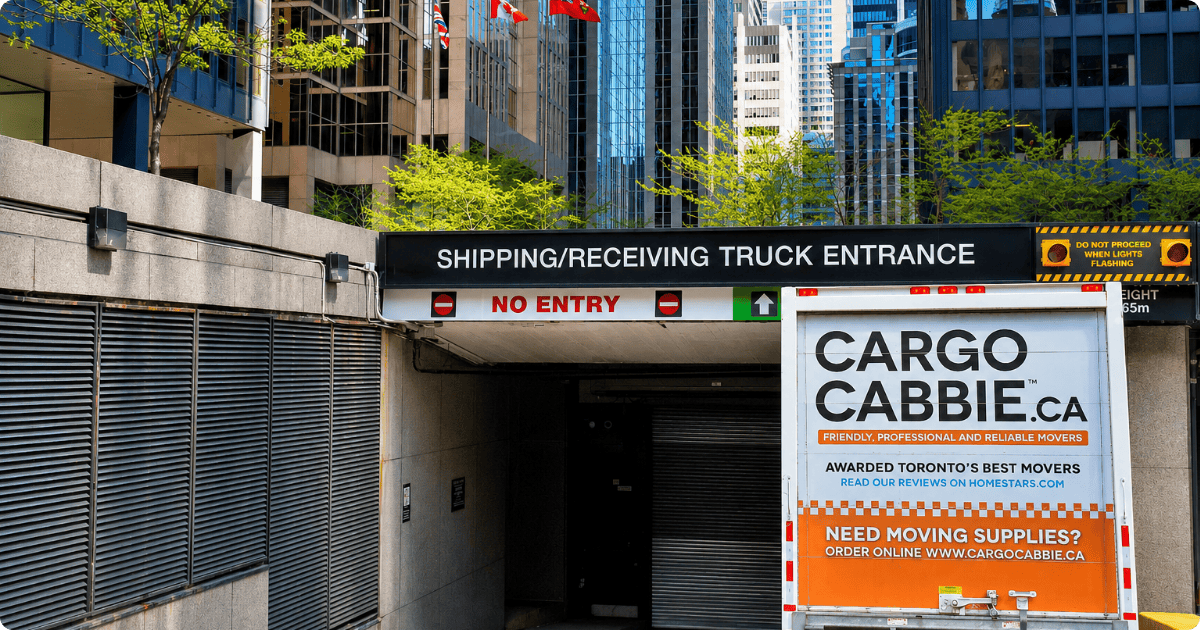
Direct answer: Condo moving in Toronto revolves around three things a house move doesn’t have: the elevator booking, the certificate of insurance (COI), and the building’s moving rules. Book your elevator the moment your closing or lease date is confirmed, ensure your mover can issue a COI naming the condo corporation, and confirm the loading dock’s truck height limit before moving day.
With condo sales surging 13.5% year-over-year in June 2026 and prices at multi-year lows, condo moves are the fastest-growing segment of Toronto moving this year — first-time buyers stepping in, investors exiting, and renters upgrading buildings while rents are negotiable.
The condo moving sequence that works
- Immediately on firm date: book the freight/service elevator with your property manager. Prime slots (Saturday mornings, month-end) vanish weeks out in busy corridors like CityPlace, Liberty Village, and Yorkville.
- 2–3 weeks out: request your building’s rules and send them to your mover. Ask for the COI requirements, most Toronto buildings require $2M–$5M liability naming the condo corporation and property manager.
- 1 week out: confirm dock height (many downtown docks max out at trucks under 13’6” or even lower), padding requirements, and whether the building requires floor protection in corridors. (We bring red floor runners to every job regardless.)
- Moving day: your crew should protect the elevator cab, prop-secure doors per building rules, and stage items in the right order so your elevator window isn’t wasted.
Condo moving mistakes we fix every week
- The two-hour elevator window for a four-hour move. Be honest about volume; an experienced estimator will tell you what fits in a window.
- No COI on file. Security can — and does — turn away moving crews without one. Any professional Toronto mover produces these routinely; if a company hesitates, that tells you everything.
- Assuming two buildings, one booking. Moving from one condo to another means two elevator bookings that must line up. This is the single most common condo-to-condo failure point, and where an experienced coordinator earns their keep.
Our dedicated condo movers Toronto team handles hundreds of these each year across downtown, North York, Mississauga and Etobicoke.
Expert Insight from CARGO CABBIE: The elevator window is the real clock on a condo move — not the truck. We plan condo jobs backwards from the elevator: heaviest and largest items first while the crew is freshest and the window is guaranteed, boxes staged in the corridor in dolly-ready stacks, one crew member dedicated to the elevator so it never travels empty. A 15-minute traffic delay can cost an entire booking window, which is why our downtown crews stage early. Amateurs load a truck; professionals manage a window.
House Moving in Toronto: The Complete Guide
Direct answer: House moves in Toronto succeed or fail on preparation: city parking permissions for the truck, protection for floors and banisters, a room-by-room labelling plan, and honest volume assessment. A typical three-bedroom Toronto house move takes six to nine hours with a professional crew of three to four movers; larger homes in Forest Hill, Rosedale, or The Kingsway often run a full day or are split across two.
What makes Toronto house moves unique
- Narrow Victorian streets and tight staircases. In The Annex, High Park, Riverdale and Cabbagetown, century homes have doorways and stair turns that modern furniture was never designed for. Experienced crews measure, disassemble, and hoist where needed — beginners force, scratch, and apologize.
- Parking logistics. On-street truck parking often needs planning: temporary no-parking arrangements, a neighbour’s driveway, or an early crew claiming legal space. A truck parked 80 metres away can add an hour or more of carry time.
- Multi-generational volume. Toronto houses accumulate. Basements, garages, and attics routinely double the estimated volume homeowners report. This is why in-home walkthrough or video estimates beat phone quotes every time.
The two-day house move (and why the best moves use it)
For larger homes, we increasingly recommend splitting the job: Day 1 — pack and prep: professional packing, disassembly of beds and large furniture, protection installed. Day 2 — move: the crew moves a fully packed, fully protected home in half the time, with far less stress and breakage risk. The total cost difference is modest; the difference in moving-day calm is enormous, especially with kids, pets, or a same-day closing.
Closing-day choreography
Ontario closings often fund in the afternoon. If keys arrive at 4 p.m., you need a mover who plans for it: morning load-out, secure truck hold or short-term storage, evening delivery — or a bridging plan. Ask any mover you interview how they handle a delayed closing; the quality of that answer predicts your whole experience. Our residential moving team builds this into every house-move plan.
Expert Insight from CARGO CABBIE: The single highest-value hour in a house move is the pre-move walkthrough. We check stair widths, banister clearances, hose bib location (for cleaning runners), which windows a sofa hoisted once before, and where the truck legally fits. Sixteen years of Toronto houses has taught us that surprises are just measurements nobody took.
The Complete Toronto Downsizing Guide
Direct answer: Downsizing in Toronto works best as an 8–12 week staged process: sort and declutter (weeks 1–4), sell/donate/remove (weeks 4–6), stage and list if selling (weeks 6–8), then move once, deliberately (weeks 8–12). In 2026’s market, high accumulated equity, softer prices on larger homes, abundant condo choice, downsizing is the most financially powerful move available to long-time GTA homeowners.
Why 2026 is a genuine downsizing moment
Long-time owners in neighbourhoods like Forest Hill, Rosedale, North York and The Kingsway are sitting on decades of appreciation, while the condos and townhomes they’d downsize into are at their most negotiable prices in years, condo apartments averaged $630,688 in June, down 9.4% year-over-year. Selling a large home and buying smaller has rarely had a wider spread. Add mortgage-renewal pressure and the math often makes itself.
The CARGO CABBIE staged downsizing method
Stage 1 — The four-pile sort (weeks 1–4). Keep / Family / Sell-Donate / Remove. One room at a time, starting with the easiest (linen closet), ending with the hardest (memorabilia). Momentum matters more than speed.
Stage 2 — Out before you list (weeks 4–6). Furniture removal and donation runs clear the home. Anything you’re keeping but can’t yet place goes into storage, decluttered homes photograph better, show better, and sell for more. Ask any Toronto agent.
Stage 3 — The measured move (weeks 6–12). Floor-plan the new home before moving day. We regularly see downsizers pay to move sofas that never had a wall to go on. Measure, plan, and move only what fits the new life, everything else is sold, gifted, donated, or stored for family.
The emotional side (the part everyone underestimates)
Forty years of a family home doesn’t sort itself in a weekend, and it shouldn’t. Build in time for the photo boxes. Involve family early for the “Family” pile. And if the process stalls, a patient professional crew that has done hundreds of these — packing carefully, never rushing decisions, changes everything. This is a core part of our white-glove service, and it’s some of the most meaningful work we do.
Expert Insight from CARGO CABBIE: The most successful downsizes we’ve handled share one habit: they downsize the storage spaces first. Basement, garage, attic — before a single living-room decision. Those spaces hold 80% of the “remove” pile and almost none of the emotional weight, so families build sorting stamina before they reach the hard rooms. Start in the basement, finish in the living room. Never the reverse.
Downsizing this year? CARGO CABBIE offers decluttering support, furniture removal, storage, and the careful move itself, one team, one plan.
Furniture Removal & Decluttering in Toronto
Direct answer: Professional furniture removal in Toronto typically costs $250–$800 depending on volume and access, and responsible services sort items into donation, recycling, and disposal streams rather than sending everything to landfill. In 2026, removal demand is up sharply — driven by downsizing, pre-listing decluttering, renovation prep, and estate transitions.
When furniture removal is the answer
- Before listing a home. Toronto agents consistently report that decluttered homes sell faster and better — and in a balanced 2026 market, presentation is leverage.
- During downsizing or estate transitions. One crew, one afternoon, and the hardest logistical piece of a family transition is done with dignity.
- After a renovation or furniture upgrade. The new sectional arrives; the old one needs a respectful exit.
- Condo dwellers. Getting a sofa out of a high-rise involves the same elevator bookings and COIs as getting it in, one reason DIY disposal fails so often downtown.
Where things actually go
A professional service should be able to tell you: usable furniture to donation partners, metals and electronics to recycling, and only true waste to disposal — with City of Toronto rules followed for mattresses and appliances. Ask. If a company can’t answer, your grandmother’s dresser is going to landfill. Our furniture removal Toronto team sorts every load.
Expert Insight from CARGO CABBIE: The most common removal call we get is “one sofa” that becomes half a basement once we arrive. Send photos of everything you’re unsure about when you book, a crew sized for the real job costs less than a second trip. And if an item is genuinely good, tell us; we’d rather route it to donation than the transfer station, and so would you.
Renovation Moving: Living Through a Toronto Reno
Direct answer: Renovation moving means clearing rooms or entire floors into on-site staging or off-site storage before contractors start, then returning everything after — and it’s the difference between a renovation quoted accurately and one delayed by furniture in the way. With many GTA households renovating rather than transacting in 2026, this is one of the fastest-growing services in the city.
The three renovation-moving models
| Model | Best For | How It Works |
|---|---|---|
| In-home shuffle | Single-room renos | Crew moves contents to other rooms/garage, protects everything, returns after |
| Storage bridge | Kitchen, main-floor, or multi-room renos | Contents packed, moved to climate-controlled storage, redelivered on completion |
| Full relocation | Gut renovations, additions | Household moves out entirely; staged storage + temporary-home move + return move |
Why contractors love (and quote better around) empty rooms
Contractors price risk. Rooms full of furniture mean protection costs, liability, and slower work — all of which lands in your quote or your timeline. Clients who clear the workspace before demolition day routinely report smoother projects. Several Toronto contractors and designers refer clients to us for exactly this reason: our in-home moving and storage moving teams clear a main floor in a morning.
Timing the return move
The classic renovation mistake: booking the return move for the contractor’s promised completion date. Renovations slip; that’s not cynicism, it’s scheduling reality. Book storage with flexible month-to-month terms and schedule redelivery only when the site is actually done — including that final coat of floor finish that needs days to cure before furniture touches it.
Expert Insight from CARGO CABBIE: Ask your floor installer for the cure time in writing before booking redelivery. Newly finished hardwood can look ready days before it can safely take a loaded bookcase, and felt pads are not a force field. We’ve seen beautiful renovations marked in their first hour by a return move booked one week too early. The floor decides the date — not the calendar.

The Professional Packing Guide
Direct answer: Professional packing follows a simple hierarchy: right box for the item, heavy items in small boxes, every box labelled by destination room and contents, fragiles wrapped individually with paper (not just bubble), and boxes packed full so they don’t crush. A one-bedroom home is typically a half-day professional pack; a full house takes one to two days with a trained crew.
Room-by-room, the way pros do it
- Kitchen (the marathon): dish-barrel boxes with cell dividers for glassware and china; plates packed vertically like records, never flat; paper-wrap every piece. The kitchen alone is often a third of total packing time.
- Books & heavy items: small (1.5 cu ft) boxes only. A large box of books is a back injury with handles.
- Wardrobes: hanging clothes go straight into wardrobe boxes — closet to closet without folding.
- Art & mirrors: picture boxes with corner protection; large or valuable pieces get custom crating (see our luxury section).
- TVs: original box or a proper TV box with foam kit — a moving blanket is not TV protection.
- Electronics: photograph the cable setup before unplugging; bag and label cables per device.
Label like your future self is a stranger
Every box: destination room + three-word contents + fragile marking on two sides. On delivery day, boxes flow to the right rooms without a single question, and unpacking becomes finding, not archaeology.
DIY, hybrid, or full-service?
- Full DIY suits studios and minimalists with two-plus weeks of lead time.
- Hybrid, you pack books and clothes; pros pack kitchen, art, and fragiles — is the sweet spot for most families and the option our clients choose most.
- Full-service packing means a crew packs the entire home in a day or two — the standard choice for busy professionals, downsizers, and every white-glove move. Details at our packing services Toronto page.
Expert Insight from CARGO CABBIE: The #1 packing failure we see isn’t technique, it’s the timeline. DIY packers almost always misjudge by a factor of two, and the last 20% gets thrown loose into bags at midnight. Our rule of thumb from thousands of moves: count your rooms, double the number, and that’s your packing days if you do two focused hours a day. If that math doesn’t fit your life, hybrid packing exists for exactly this reason.
The Moving Supplies Guide
Direct answer: A typical one-bedroom Toronto move needs roughly 20–30 boxes, a two-bedroom 40–60, and a three-bedroom house 70–100+, plus packing paper, quality tape, mattress covers, and wardrobe boxes. Reusable plastic bin rentals are the popular 2026 alternative — delivered stacked, picked up after, no breakdown, no waste.
What a real supply list looks like
| Home Size | Small Boxes | Medium | Large | Wardrobe | Paper/Bubble |
|---|---|---|---|---|---|
| Studio/1-bed | 10-12 | 8-12 | 4-6 | 2-3 | 5-10 lbs paper |
| 2-bedroom | 15-20 | 15-20 | 8-12 | 4-6 | 10-15 lbs |
| 3-bed house | 25-35 | 25-35 | 12-18 | 6-10 | 20-25 lbs |
Plus, always: 4+ rolls of proper packing tape with dispensers (not household tape), a marker per packer, mattress bags, and sofa/chair covers for anything you love.
Boxes vs. bins in 2026
Cardboard wins for storage, mixed timelines, and anything staying packed more than a couple of weeks. Rented plastic bins win for direct home-to-home moves: stronger, stackable, weatherproof, no assembly, and nothing to dispose of after, sustainability with a convenience upgrade. Toronto renters and condo movers have made bin rental our fastest-growing supply option.
Everything above is stocked at the CARGO CABBIE Box Shop in Etobicoke — voted one of Toronto’s best, with room-based moving kits that take the guesswork out entirely.
Expert Insight from CARGO CABBIE: Free grocery-store boxes cost more than they save. They’re inconsistent sizes (so they stack badly and shift in transit), often weakened by moisture, and occasionally come with insects — a genuine problem we’ve seen enter storage units. If budget is the constraint, buy proper small and medium boxes for anything heavy or breakable and economize on large boxes for linens and pillows. Uniform boxes load tighter, and tighter loads travel safer.
The Toronto Storage Guide
Direct answer: For most moving-related needs, full-service storage — where your movers pack, transport, store in a climate-controlled facility, and redeliver — beats self-storage on both effort and total cost, because you avoid double-handling, truck rentals, and damage risk. Storage demand in Toronto is elevated in 2026, driven by closing gaps, renovations, downsizing, and staging.
Self-storage vs. full-service moving storage
| Factor | Self-Storage Unit | Full-Service (CARGO CABBIE model) |
|---|---|---|
| Labour | You move everything - twice | Crew handles all handling |
| Transport | You rent trucks - twice | Included in the plan |
| Protection | Your wrapping skills | Professionally wrapped, padded, inventoried |
| Climate control | Varies; often extra | Standard |
| Access | Drive-up anytime | By appointment (inventory retrieval) |
| Real total cost | Unit + trucks + your weekends | One transparent bundle |
Self-storage genuinely wins when you need frequent access — seasonal gear, business stock, hobby equipment. For transition storage (between homes, during a reno, while staging), full-service is faster, safer, and usually cheaper once truck rentals and your Saturdays are priced honestly.
What must be climate-controlled in a Toronto winter/summer
Wood furniture (joints and veneer), pianos and instruments, leather, artwork, electronics, photographs, wine. Toronto swings from −20°C to +35°C with humidity to match; a non-climate unit turns solid-wood furniture into a cracking risk within one season. Our moving and storage facility in Etobicoke is climate-controlled as standard, with every item inventoried on intake.
Storage as a strategy, not a fallback
The savviest 2026 uses we’re seeing: sellers storing a third of their furnishings to stage lean and sell high; downsizers storing the “undecided” pile so moving day only moves the certain; renewal-pinched owners storing while they rent for a year and watch the market. Storage isn’t where things go to be forgotten, it’s how flexible people buy time.
Expert Insight from CARGO CABBIE: Photograph every box’s contents before it’s sealed for storage and keep the photos in one album on your phone, matched to our inventory numbers. Six months later, “which box has the winter boots?” is a 30-second scroll instead of a retrieval appointment. Small habit, enormous payoff, and it’s the first thing our storage veterans tell new clients.
Between homes, renovating, or staging to sell? Ask about CARGO CABBIE’s bundled move + storage plans.
Senior Moving with Care
Direct answer: Senior moves succeed when they run at the senior’s pace: a longer planning runway (8–12 weeks), family involved early, belongings sorted with patience rather than deadlines, and a moving crew trained to treat the day as a life transition, not a logistics job. Demand for senior and retirement-residence moves keeps rising across the GTA as the population ages and downsizing accelerates.
What makes a senior move different
- The floor plan comes first. Retirement residences and condos have exact suite dimensions. We plan furniture placement on paper before packing, so the bed, the reading chair, and the dresser that matter most are guaranteed a place.
- The first night is the goal. A great senior move ends with the bed made, the kettle findable, medications and documents in a clearly marked “open first” box, and pictures on the wall. Waking up in a home, not a box maze, changes the whole transition.
- Family coordination. Adult children are often in Oakville, Vaughan, or another city entirely. A single point of contact who communicates with everyone prevents the “I thought you told Mom” failures.
- Estate sensitivity. Many senior moves pair with our furniture removal and donation services for the family home, handled respectfully, with keepsakes routed to family members across the GTA.
Our crews handle these moves with the same white-glove standard as our luxury work, because the stakes, a lifetime of belongings and a major life transition, are just as high. See our dedicated senior movers in Toronto page for the full service, the downsizing process and answers to the questions families ask most.
Expert Insight from CARGO CABBIE: On senior moves we always recommend the “memory table”: one table at the old home where the mover-in places the small items they absolutely must see in the new home on day one, photos, the clock, the good teacups. It travels in its own labelled box, last on, first off, unpacked first. It sounds small. It is, in our experience, the single most appreciated fifteen minutes of the entire move.

Office Moving in the GTA
Direct answer: A well-run GTA office move happens over a weekend with zero business-day downtime: pre-move labelling of every desk and asset, IT-coordinated disconnect Friday evening, move Saturday, reconnect and test Sunday, staff working Monday morning. In 2026’s consolidation economy, with businesses right-sizing footprints amid trade uncertainty — office moves are one of the busiest categories in the city.
The office move framework
- 8+ weeks out: appoint an internal move champion; book building elevators at both ends (commercial buildings have COI and after-hours rules just like condos); inventory what’s moving vs. being decommissioned.
- 4 weeks out: numbering system issued — every desk, chair, monitor and crate gets a destination code matching a floor plan. IT plans the disconnect/reconnect.
- 1 week out: staff pack personal items into labelled crates; furniture disassembly scheduled; secure shredding and e-waste streams arranged for what’s not moving.
- Move weekend: Friday disconnect, Saturday physical move, Sunday IT restore and furniture assembly, Monday open for business.
The 2026 wrinkle: consolidations and downsizes
Many of this year’s office projects aren’t A-to-B moves, they’re two-offices-into-one, or a full floor into a half floor. That means the move plan is also a decommissioning plan: furniture liquidation, donation, recycling, and storage of assets the business isn’t ready to release. Our office movers Toronto team runs both sides of that plan, from Bay Street towers to Liberty Village studios to Mississauga business parks.
Expert Insight from CARGO CABBIE: The metric that matters in an office move isn’t hours, it’s employee minutes lost. A move that costs $2,000 less but leaves 40 staff hunting for monitors on Monday morning is the most expensive move you can buy. Insist on a numbered floor-plan system and a Sunday walkthrough. When people sit down Monday and everything simply works, that’s what professional looks like.
Luxury & White-Glove Moving
Direct answer: White-glove moving means every stage is engineered around protection: full floor and wall protection at both homes, individual wrapping of every furniture piece in premium materials, custom crating for art and fragile valuables, detailed inventory tracking, and uniformed crews trained for high-value homes. It’s the standard for fine homes in Yorkville, Rosedale, Forest Hill and The Kingsway, and for anyone whose belongings warrant it.
What “white glove” actually includes at CARGO CABBIE
- Site protection first. Red floor runners, door-jamb guards, banister wrap, and corner protection installed before a single item moves, at origin and destination.
- Custom crating. Artwork, mirrors, sculptures, chandeliers, marble and glass travel in built-to-fit crates, not blankets and hope.
- Inventory discipline. High-value moves get item-level inventory with condition notes, so a 200-piece designer install arrives verifiably complete.
- Designer receiving. We receive, inspect, store, and deliver furniture shipments for interior designers, then place and assemble on install day, the logistics backbone of design projects across the city’s finest neighbourhoods. See our white glove moving Toronto service.
- Specialty pieces. Pianos are their own craft — weight distribution, board work, humidity planning — handled by our piano moving services team.
Who books white glove in 2026
Luxury homeowners, yes, but increasingly also downsizers with fine furniture, collectors, and estates in transition. The 2026 luxury resale segment moves more slowly than the mid-market, which means luxury moves are planned moves — and planned moves are where white-glove service shines, often across two staged days.
Expert Insight from CARGO CABBIE: True white glove is measured by what you notice afterwards: nothing. No scuff at the stair turn, no dust ring where a crate stood, runners rolled up and gone. Our internal standard is that the only evidence we were in a Rosedale home is that everything is now in the right one. If a “luxury” mover can’t explain their floor-protection and crating process in concrete detail before booking, the label is marketing.

Neighbourhood-by-Neighbourhood Moving Tips
Direct answer: Every Toronto neighbourhood has its own moving personality, condo elevator queues downtown, narrow Victorian staircases in the west end, long driveways and gated access in the north, and highway-timing decisions in the 905. Here’s what 16 years of GTA moves has taught us, area by area.
- Yorkville & The Annex: luxury condo towers with strict COI and dock rules meet century homes with tight stair turns, often in the same move. Book elevators early; expect white-glove standards. (Yorkville movers)
- Forest Hill & Rosedale: steep driveways, mature-tree canopies that limit truck height, and fine interiors that demand full protection. Two-day moves are common. (Forest Hill movers, Rosedale movers)
- Liberty Village & CityPlace: the densest elevator competition in the city. Month-end Saturdays book out weeks ahead; mid-week moves are dramatically smoother.
- High Park & Roncesvalles: beautiful Edwardian homes, narrow one-way streets, and permit-parking blocks — truck placement is half the plan. (High Park movers)
- The Kingsway & Etobicoke: larger lots and easier parking, but long carries from door to truck; hoisting is occasionally needed for oversized pieces into older homes. (Etobicoke movers)
- Mimico & the waterfront: a mix of new towers and postwar bungalows; watch condo dock height limits near the lake towers.
- North York: high-rise corridors along Yonge with heavy move traffic — elevator bookings matter as much as downtown. (North York movers)
- Mississauga, Oakville & Burlington: 905 house moves live and die on highway timing; we route around Gardiner/QEW peaks and plan morning load-outs. (Mississauga movers, Oakville movers)
- Vaughan & the northern GTA: newer subdivisions with easy access but long distances, volume-accurate estimates keep drive time from becoming the cost driver.
Expert Insight from CARGO CABBIE: The most Toronto move that exists: Victorian house in The Annex to a Yorkville tower. Two completely different skill sets, stair-and-hoist work in the morning, dock-and-elevator choreography in the afternoon, inside one booking window. When you interview movers, ask how many of your specific building or street they’ve done. Local pattern recognition is the product you’re actually buying.
The Best Time to Move in Toronto
Direct answer: The cheapest, calmest Toronto moves happen mid-month, mid-week, from October through April. The most expensive and most competitive are month-end weekends from June through September, with July 1 and the last weekend of any month as the peak. If your dates are flexible, shifting even three days off month-end can improve both price and crew availability.
The Toronto moving calendar
| Period | Demand | Notes |
|---|---|---|
| Jan-Mar | Lowest | Best rates; watch for storm-day contingency plans |
| Apr-May | Building | Spring market closings begin; good balance of weather + availability |
| Jun-Sep | Peak | Leases turn over, families move between school years; book 3-6 weeks ahead |
| Oct-Nov | Moderate | Excellent conditions; our crews' favourite season |
| Dec | Low | Quiet except pre-holiday corporate moves |
Within any month: the 1st and the last 3 days are peak (lease cycles and closings). Within any week: Saturday is peak; Tuesday–Thursday are the value days.
Timing and the 2026 market
Here’s the strategic layer this year: TRREB expects buyer competition to accelerate in the second half of 2026, and moving demand follows transactions with a short lag. Translation, fall 2026 is likely to be busier than fall 2025. Booking earlier than you think necessary is the cheap insurance.
Expert Insight from CARGO CABBIE: Winter moving in Toronto is underrated. Yes, we plan for weather, runners, mats, wrapped doorways, salt-safe floor protection, but crews are fresh, elevators are free, trucks aren’t fighting festival closures, and rates are at their best. Some of the smoothest moves we run all year are sunny, −5°C February mornings. If your dates are flexible, don’t fear the winter; fear the last Saturday of June.
The 12 Most Common Toronto Moving Mistakes
Direct answer: The costliest Toronto moving mistakes are booking too late, taking phone-only quotes, skipping the elevator booking, hiring uninsured movers, and underestimating volume. Every one of them is preventable with two to four weeks of lead time and the right questions.
- Booking two weeks before a month-end summer move. The good crews are gone; you’re choosing from what’s left.
- Accepting a phone quote for a full house. Volume is visual. Insist on an in-home or video estimate.
- Forgetting the elevator booking, or booking one building of a condo-to-condo move but not the other.
- Hiring the cash-only bargain. No insurance, no COI, no recourse. The gray market is where our founder’s stolen-belongings story began in 2010.
- Not asking about the COI until moving day. Building security will turn the crew away, full stop.
- Packing heavy items in large boxes. Boxes fail, backs fail, and loading slows.
- Leaving the basement and garage out of the estimate. The classic 30–50% volume surprise.
- Booking the return-from-storage move for the contractor’s “promised” date. Renovations slip; flexible storage terms exist for a reason.
- Moving everything, deciding later. You pay to move furniture that never finds a wall. Measure the new home first; declutter before, not after.
- No “open-first” box. Kettle, chargers, medications, sheets, toilet paper, and the TV remote. Trust us on the remote.
- Scheduling delivery before a delayed closing is truly funded. Have a bridge plan; ask your mover for theirs.
- Choosing on price alone. The cheapest quote and the lowest final cost are frequently different companies. Damage, delays, and day-of surcharges are how bargains get expensive.
How to Choose a Moving Company in Toronto
Direct answer: Choose a Toronto mover on five verifiable criteria: proof of insurance and ability to issue a COI, a written itemized estimate, consistent recent reviews on Google and HomeStars, a real local address you can visit, and direct experience with your building type or neighbourhood. If a company fails any one of these, keep looking, Ontario’s moving industry is loosely regulated and the burden of vetting falls on you.
The five-point verification
- Insurance & COI. Ask for proof of liability coverage and confirm they routinely issue certificates naming condo corporations. Professionals answer in minutes.
- Written estimate. Itemized, with hourly rates, truck fees, and what’s included stated plainly, and honoured on moving day. Vague “we’ll see” pricing is the industry’s oldest trap.
- Review pattern, not review score. Read the most recent 20 reviews and, critically, how the company responds to problems. Every mover eventually faces a tough day; character shows in the reply. CARGO CABBIE has been a HomeStars Best of Award winner and a BlogTO best-movers pick year after year, and our reviews are public and current.
- A real address. A facility you can visit, ours is in Etobicoke with a public Box Shop — means the company exists beyond a phone number and a rented truck.
- Relevant experience. “Have you moved this building / this street / this kind of piano?” Specific answers signal a company that has actually done it.
Red flags that end the conversation
Large cash deposits. Quotes wildly below every other estimate. No physical address. Reluctance to put anything in writing. A truck that arrives unbranded with a crew you didn’t book. Ontario’s consumer-protection files are full of exactly these patterns.
For a deeper checklist, our post on the CARGO CABBIE story and how to vet movers breaks down the vetting table in detail.

21 Questions to Ask Any Toronto Mover
Direct answer: Before booking, ask about insurance, COIs, written estimates, crew employment status, and building experience. A professional company answers all 21 of these without hesitation.
Credentials & protection Are you fully insured, and can I see proof? Can you issue a COI naming my condo corporation and property manager? Are your movers employees or day labour? What protection plans cover my belongings, and what are the limits? 5. Do you have a physical facility I can visit?
Pricing Is the estimate written and itemized? What exactly is included, travel time, materials, stairs, disassembly? Under what circumstances could the final price differ from the estimate? Do you require a deposit, and how is it paid? Are there fuel, weekend, or seasonal surcharges?
Logistics How many moves like mine (building/street/home type) have you done? How do you handle elevator bookings and time windows? What’s your plan if my closing is delayed on move day? What floor and wall protection do you install as standard? How do you protect furniture, wrapping materials and method? What size trucks do you run, and will one fit my building’s dock or street?
Services & contingencies Do you offer packing, supplies, and storage under one plan? How are specialty items (piano, art, marble, safes) handled? What’s your weather plan for a winter move? What is your claims process if something is damaged? Who is my single point of contact from booking to delivery?
The Complete Toronto Moving Checklist
Direct answer: Start eight weeks out with decluttering and mover research, book movers and elevators by week six, pack progressively from week four, confirm all logistics in the final week, and reserve moving day for supervision, not packing.
8 weeks before – Declutter room by room (start with basement/garage/attic) – Research and shortlist movers; request written estimates – Book furniture removal / donation pickups for what’s not coming – If selling: coordinate decluttering + storage with your listing timeline
6 weeks before – Book your mover (and storage if bridging) – Book freight elevators at both buildings; request building rules and COI requirements – Order supplies or reserve rental bins – Start using up freezer and pantry stock
4 weeks before – Begin packing rarely used rooms; label every box (room + contents) – Arrange address changes: CRA, ServiceOntario (licence & health card), banks, insurance, subscriptions – Schedule utility disconnect/connect (hydro, gas, internet – internet installs book out, do it now) – Arrange kids/pets care for moving day
2 weeks before – Confirm movers, elevator windows, and parking plans in writing – Pack everything except daily essentials – Ship or transport valuables (jewelry, documents, passports) personally, never in the truck – Defrost plans for fridge/freezer if it’s moving
Final week – Pack “open-first” boxes (kitchen basics, bathroom, chargers, tools, remote) – Photograph electronics setups; bag hardware from disassembled furniture and tape to the piece – Reconfirm closing/key timing with your lawyer or agent – Set aside payment, tip cash if desired, and snacks/water for the crew
Moving day – Walk the crew through both homes; point out fragile and priority items – Keep essentials, valuables, and documents with you – Final sweep: every closet, cabinet, dishwasher, and the back of every door – Record utility meter readings; leave keys/fobs as arranged
First week after – Beds first, kitchen second, everything else in order of use – Test appliances and plumbing; report any moving claims promptly – Update remaining addresses; register with a new pharmacy if needed – Break down boxes for recycling, or schedule bin pickup if you rented
Expert Advice from 17 Years on Toronto Streets
Direct answer: After 17 years and thousands of GTA moves, the pattern is unmistakable: the moves that go beautifully are planned around constraints (elevators, closings, cure times, weather) rather than dates, they move less stuff rather than more boxes, and they treat the moving crew as partners with full information rather than strong backs with an address.
A few truths we’d tell any friend:
Move less. The single highest-return hour of any move is spent deciding what doesn’t come. Every skipped box is money, time, and a decision you never have to make at the other end.
Buy certainty, not hours. The difference between a $1,800 move and a $2,300 move is usually insurance, training, protection materials, and a company that shows up when the elevator window opens. That $500 is the cheapest certainty you’ll ever buy on a six-figure transaction day.
Tell your movers everything. The spiral staircase, the sticky dock door, the 4 p.m. closing, the piano nobody mentioned. Surprises are the only thing that makes moves expensive. Information makes them smooth.
Respect the calendar, exploit the calendar. If you must move June 30, book in May. If you can move November 12, you’ll get the A-crew at the year’s best value.
And the 2026-specific advice: this is a mover’s market — in housing, in rentals, and in the leverage you hold. TRREB’s own outlook says the second half of the year tightens. The people who act while conditions favour them will look back on 2026 the way early-2019 movers look back now.
A closing word from Javier Lirman, Founder & CEO: “I started CARGO CABBIE in 2010 after my own move went as badly as a move can go. Sixteen years later, the mission hasn’t changed: build the moving company I wished existed that day. Every guide on this page is the advice we give our own families. If you’re moving anywhere in Toronto or the GTA this year, we’d be honoured to earn your trust, starting with a clear, honest estimate.”
Ready to plan your 2026 move? Get a free, written, no-obligation estimate from CARGO CABBIE , Toronto’s most awarded premium movers. Call 647.478.5422 or request a quote online.
Frequently Asked Questions: Moving in Toronto (2026)
Costs & booking
1. How much does it cost to hire movers in Toronto in 2026?
Most local moves run $600–$1,400 for a one-bedroom, $1,400–$2,400 for a two-bedroom, and $3,000–$4,500 for a three-bedroom house, depending on access, date, and services. Get a written estimate, it’s the only number that counts.
2. How far in advance should I book Toronto movers?
Three to six weeks for summer or month-end dates; two to three weeks is usually workable off-peak. Office moves need six to eight weeks for elevator and IT coordination.
3. Is it cheaper to move mid-week in Toronto?
Yes. Tuesday–Thursday, mid-month moves typically get the best rates and crew availability. Month-end Saturdays are the most expensive slots of the year.
4. Should I tip my movers?
Tipping isn’t required but is appreciated for great work — commonly $20–$50 per mover for a standard move, more for exceptional or full-day jobs.
5. What’s included in a professional moving estimate?
Crew size, hourly rate or flat price, travel time, truck, protection materials, and any add-ons (packing, storage, specialty items) — all in writing. Ask about anything vague.
6. How do I book a moving elevator in a Toronto condo?
Contact your property manager or concierge as soon as your date is firm. You’ll typically reserve a two-to-four-hour window and may need a deposit and your mover’s certificate of insurance.
7. What is a COI and why does my building want one?
A certificate of insurance proves your mover’s liability coverage and names the condo corporation, protecting the building from damage claims. Professional Toronto movers issue them routinely, usually within a day.
8. What should never go in the moving truck?
Passports and documents, jewelry, cash, medications, laptops, and anything irreplaceable — keep them with you. Also propane tanks, paints, and other hazardous items, which movers can’t legally transport.
9. How do I know a Toronto moving company is legitimate?
Verify insurance, ask for a COI sample, read the latest 20 reviews on Google and HomeStars, confirm a real physical address, and get everything in writing. No legitimate company resists any of these.
10. What if something is damaged during my move?
Note it on the spot, photograph it, and report it through the company’s claims process promptly. Ask about protection plans and claim procedures before booking, the quality of that answer predicts the experience.